I had a technical problem along about the time that family obligations spiked, which led to me eyeing but not touching the loom for a while. I'm back now.
The technical problem I experienced involved those selvedge yarns. While I had no trouble with their unspinning themselves, they did nevertheless loosen. The Navajo warp is so loosely spun that it slowly lengthened and eventually pulled apart. After I'd mended a selvedge thread for the third time, I decided to replace rather than repair.
First I needed a good replacement yarn. I found something at the local yarn shop that would serve: Kraemer Natural Skeins Eileen, a DK-weight merino yarn. It is tightly three-plied, soft but not at all delicate, and the appropriate off-white color of undyed wool. (After this project is over, I'll come up with some interesting way to use the rest of it; it's not a bad weight for nålebinding.) Instead of the two ends of Navajo warp per selvedge, I'm using two ends of this yarn per selvedge.
The second challenge was to replace the selvedge yarn. Using a tapestry needle, I tried threading one end up through the woven selvedges to parallel the Navajo yarn. The selvedges are in a wrapped technique (two additional turns of yarn between each pick), which means I had a lot of tiny weft loops through which to stick the needle. Standing on my little wooden stool and doing that was such fiddly work that I gave it up after an inch's worth. Instead, I anchored the new selvedge yarn around the warp beam, leaving a generous unworked end at the top. Then I weighted the new selvedges, put them where they belonged, and set the loom to rights.
When I remove the web from the loom, the first thing I will do is, as they say in the weaving magazines, "correct the errors." I'll start by threading that unworked end of each new selvedge yarn through the weft loops in a way that does not involve me teetering on a stool with arms outstretched leaning forward against thin air. (Tables are a grand human invention, and I wonder that we fiber folk do not make more use of them than we do.) Then I'll remove the vestiges of the old selvedge yarns. Then I'll fix any warp threads that have had to be repaired.
Oh yes, warp repairs. So far three warp yarns have broken. They all belong to one weight hanging at the back of the loom, i.e., they all come from the heddled back layer rather than the laced front layer. (I expected that broken warps would occur with the laced layer, which is secured firmly at a fixed point rather than movable, but so far that layer has held up beautifully.) The weight in question comes from the central point of the warp, the area where the two shed sticks overlap, the area I have to baby along with every change of shed. This area is subjected to more movement, stress, and displacement than the rest of the warp combined; it's not surprising that even this really high quality warp yarn is showing signs of wear. Fortunately, I have some experience fixing broken warps on my horizontal loom. The same principle applies here, so I'm not sweating it. If warps continue to break in that area, though, it could become a problem.
With about a foot of weaving done, I have to say that I'm not entirely convinced about the theory of using two short shed rods rather than one long one on a wide warp. My experience so far suggests it's more of a hassle than otherwise. The central two inches of the warp display a much looser sett than the rest of the warp, which is not surprising given how much more manipulation it undergoes than the rest of the warp does. Since I'll be working in that area to rectify the broken warps, maybe I'll also be able to ease the sett a little closer, drawing from the surrounding area where the sett is (naturally) a little tighter.
On the other hand, perhaps if both the rods were pulled at the same time, as by two weavers working side by side, it might be a fine solution. But for one weaver working alone at a wide warp, I'm just not sure this is the way to do it. But then, that was the whole point of this project, wasn't it? I'm looking for proof (or not) of concepts.
22 May 2012

31 March 2012
First turn of the cloth beam
After 6" of weaving, it was time to make the first turn of the cloth beam. At first 6" was just an arbitrary marker, the goal I set for myself to weave before turning the beam. But then I looked at this.
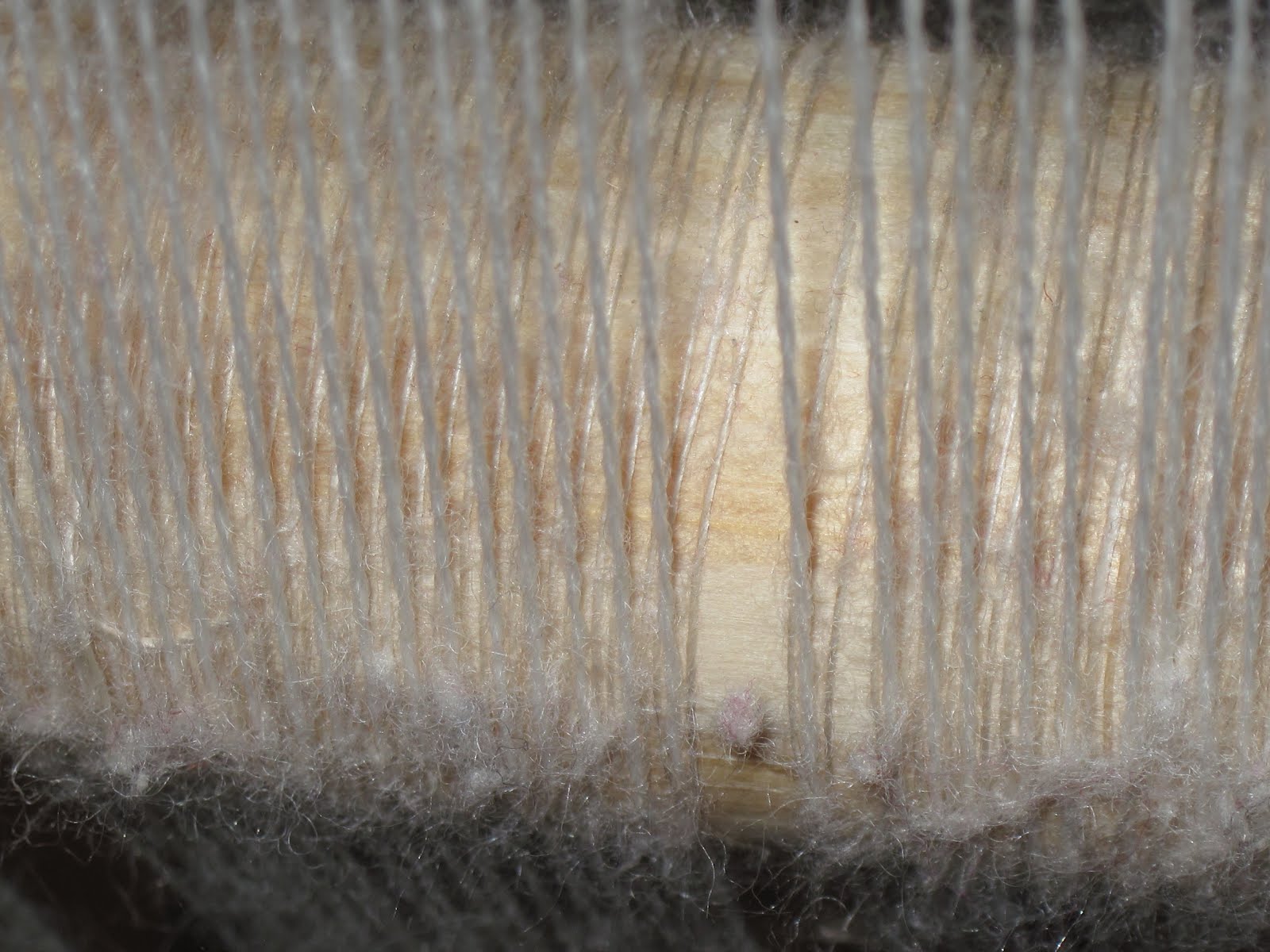
 Here you can see the buildup of fuzz on the shed rod. The warp is casting off fibers as it moves up and down in the shed rod lacing. Because this is a very nicely spun worsted yarn there are not a lot of loose fibers to shed, but it's still happening. Partly that's because of the way I beat. When I weave on the warp-weighted loom I don't actually "beat" the weft, I simply put the edge of the beater against the fell and press upward evenly until I feel that I am lifting the weight of the loom weights. Thus I make gravity and the loom weights work for me rather than expending all that whomp-whomp-whomp upward-beating energy that feels good to do but doesn't have as even and satisfactory a result--at least, not in my experience. YMMV. But my method does shift the front shed's worth of warp up and down slightly through its lacing, which encourages this slight fraying and build-up.
So it seems to me that it would be a good idea to turn the cloth beam rather frequently, in order to give each section of the warp threads as short a time as possible in that constraining position against the shed rod. Although I didn't take a photo of it, I also noticed some slight fuzz buildup on the heddles. I expect that frequent turning will save the warp threads from wear in that position also.
 This is a shot of the warp after six inches had been woven but before any turning of the cloth beam had taken place.
 This is how the warp looks after the first turning. It was a quarter-turn of the cloth beam (which is square in cross-section). Next time I think I'll try a half-turn.
One thing I have noticed about this project: there isn't a lot of fibery fluff building up under the loom the way there usually is when I weave on a warp-weighted loom. I think that's probably due, again, to the superior quality of this yarn. So far, the only thing we've had to vacuum out from under the loom has been cat hair. Mercifully, my cat is entirely disinterested in the enticingly dangled weights of this project, but somehow his hair gets under the loom anyway.
So it seems to me that it would be a good idea to turn the cloth beam rather frequently, in order to give each section of the warp threads as short a time as possible in that constraining position against the shed rod. Although I didn't take a photo of it, I also noticed some slight fuzz buildup on the heddles. I expect that frequent turning will save the warp threads from wear in that position also.


One thing I have noticed about this project: there isn't a lot of fibery fluff building up under the loom the way there usually is when I weave on a warp-weighted loom. I think that's probably due, again, to the superior quality of this yarn. So far, the only thing we've had to vacuum out from under the loom has been cat hair. Mercifully, my cat is entirely disinterested in the enticingly dangled weights of this project, but somehow his hair gets under the loom anyway.
27 March 2012
The honeymoon is over
One can only weave so long before a warp breaks. Yesterday I had a selvedge break, and today a regular warp broke.
The selvedge telegraphed its intention by stretching over the course of a day or two until the weight was resting on the ground. I used a pair of Navajo warp singles yarns for each selvedge. It's more loosely spun than I like, but it was the best choice I had. So now I know it's going to be troublesome and I can keep an eye out for it. I may wind up having to put some more twist into it to keep its integrity. It is, however, not unspinning itself; those warp weights are remarkably good at staying in place. It probably has something to do with those flat sides that snuggle up against their neighbors.
The regular warp break was due to a rough spot in one of my wooden tools. It caught on one ply of a warp thread and stretched it until it broke. I tried splicing the warp back together, but there wasn't much to work with and so I wound up knotting in a repair section. Luckily, it's on the back of the chiton.
I shall have to work on smoothing that rough spot down before it eats any more warps.
The good news is, I have six inches of woven cloth. That's an eighth of the project. There's a tiny piece of me that never thought I'd get this far, so I'm pretty stoked.
The next task is to even out the warp spacing in the woven cloth before reeling some of it up onto the cloth beam. This is a surprisingly easy task, readily accomplished by the pointed end of just about any tool. (I like the bone needle best for this purpose.) I can even do it with my fingers in the areas near the selvedge. But even if I can't get the warp distributed as evenly as I'd like, I'm not going to worry. Irregularities are inevitable according to what I've read. Particularly, Martin Ciszuk talks about his experience with the occurrence of "denser and more open warp areas" in his reconstructed weaves, just as he says are found on archaeological and ethnographic examples.
The selvedge telegraphed its intention by stretching over the course of a day or two until the weight was resting on the ground. I used a pair of Navajo warp singles yarns for each selvedge. It's more loosely spun than I like, but it was the best choice I had. So now I know it's going to be troublesome and I can keep an eye out for it. I may wind up having to put some more twist into it to keep its integrity. It is, however, not unspinning itself; those warp weights are remarkably good at staying in place. It probably has something to do with those flat sides that snuggle up against their neighbors.
The regular warp break was due to a rough spot in one of my wooden tools. It caught on one ply of a warp thread and stretched it until it broke. I tried splicing the warp back together, but there wasn't much to work with and so I wound up knotting in a repair section. Luckily, it's on the back of the chiton.
I shall have to work on smoothing that rough spot down before it eats any more warps.
The good news is, I have six inches of woven cloth. That's an eighth of the project. There's a tiny piece of me that never thought I'd get this far, so I'm pretty stoked.
The next task is to even out the warp spacing in the woven cloth before reeling some of it up onto the cloth beam. This is a surprisingly easy task, readily accomplished by the pointed end of just about any tool. (I like the bone needle best for this purpose.) I can even do it with my fingers in the areas near the selvedge. But even if I can't get the warp distributed as evenly as I'd like, I'm not going to worry. Irregularities are inevitable according to what I've read. Particularly, Martin Ciszuk talks about his experience with the occurrence of "denser and more open warp areas" in his reconstructed weaves, just as he says are found on archaeological and ethnographic examples.
24 March 2012
Starting to get the hang of this
There is a noticeable area of completed web visible on the loom now; I've done one-sixteenth of the length. Along the way I've started to develop some rhythms, some ergonomics, what I think of as "the dance." Every different weaving project has its own dance steps, although there are families of projects just as there are families of dance steps.
This weaving project is a little bit more stately and elaborate than some, more a pavane than The Hustle. I'm clocking one pair of wefts (a There and Back Again, if you will) every five minutes. There is a great deal faster and easier than Back Again!
But there is plenty of dance floor left upon which I may become more proficient at these steps, as I hope I will. My speed already seems blindingly fast compared to how I was doing the same things last week.
This weaving project is a little bit more stately and elaborate than some, more a pavane than The Hustle. I'm clocking one pair of wefts (a There and Back Again, if you will) every five minutes. There is a great deal faster and easier than Back Again!
But there is plenty of dance floor left upon which I may become more proficient at these steps, as I hope I will. My speed already seems blindingly fast compared to how I was doing the same things last week.
22 March 2012
ARGH!
I need a copy of an article in an issue of Bulletin du CIETA. Unfortunately, that back issue is out of print according to CIETA, so I can't just buy a copy. And there's not a library within several hundred miles that has a subscription.
*drums feet on floor helplessly*
Oh well, back to weaving.
*drums feet on floor helplessly*
Oh well, back to weaving.
21 March 2012
Spinning fates and the Song of the Loom
I really want to go to this:
Spinning Fates and the song of the Loom: the use of textiles, clothing and cloth production as metaphor, symbol and narrative device in Greek and Latin literature.
A one day round-table (June 1st) at the Danish National Research Foundation's Centre for Textile Research.
It's a bit far to go for a day-trip, though. Alas.
Spinning Fates and the song of the Loom: the use of textiles, clothing and cloth production as metaphor, symbol and narrative device in Greek and Latin literature.
A one day round-table (June 1st) at the Danish National Research Foundation's Centre for Textile Research.
It's a bit far to go for a day-trip, though. Alas.
19 March 2012
That was painful
After weaving an inch's worth of picks (24), I took a close hard look at what I was getting. The last inch of warp at the left (dexter) selvedge was weighted twice as heavily as the rest of the warp. This was due to my seat-of-the-pants call that two inches of warp was an appropriate number of ends per warp weight.
 However, the texture of the cloth at that more heavily weighted edge was completely different from, and preferable to, what I was getting elsewhere across the loom.
It was a hard decision, and I dithered for a couple of days before actually doing it. But I elected to untie and redistribute the weights across the entire warp. I didn't have enough extra loom weights to do the whole thing at 12 ends per weight, though. I did have enough to use an inch and a half (18 ends) per weight rather than the two inches (24 ends) that I had on the loom originally. So I've re-weighted the entire warp.
Now I'm working on beating that first "inch" of picks more tightly together, because it measures somewhat more than one inch in length. The heavily weighted area measured something less than an inch; I will also try to spread out the weft in that section a bit so the density is the same all the way across the warp. I am hoping I have found a happy medium that will give me a nice texture of (mostly) evenweave.
I'm also happy that the weights are distributed completely evenly across the warp now. Also, because it is more firmly stretched the warp makes a different and more clear sound now when I strum it. I feel much more optimistic about the project now.
Back to work!

It was a hard decision, and I dithered for a couple of days before actually doing it. But I elected to untie and redistribute the weights across the entire warp. I didn't have enough extra loom weights to do the whole thing at 12 ends per weight, though. I did have enough to use an inch and a half (18 ends) per weight rather than the two inches (24 ends) that I had on the loom originally. So I've re-weighted the entire warp.
Now I'm working on beating that first "inch" of picks more tightly together, because it measures somewhat more than one inch in length. The heavily weighted area measured something less than an inch; I will also try to spread out the weft in that section a bit so the density is the same all the way across the warp. I am hoping I have found a happy medium that will give me a nice texture of (mostly) evenweave.
I'm also happy that the weights are distributed completely evenly across the warp now. Also, because it is more firmly stretched the warp makes a different and more clear sound now when I strum it. I feel much more optimistic about the project now.
Back to work!
Subscribe to:
Posts (Atom)